
Flower Family
“Where flowers bloom, so does hope.” — Lady Bird Johnson
Last week, I found myself having a night out with girlfriends at a local restaurant savoring an evening of laughter, shared stories, and the easy comfort of friendship. Terri was seated next to me in the booth so we started up a conversation. She mentioned that she volunteers every Friday morning at a local farm, gathering freshly grown flowers and arranging them into beautiful bouquets.
Sparkling with delight she, always the artist, reached for her phone and began showing me photographs of her floral creations. There were dahlias, chrysanthemums and zinnias, their delicate petals bursting forth with colors. Being with Terri, whom I hadn’t seen in a while and seeing these gorgeous flowers, I was swept up in a sense of wonder. “Tell me more about the farm and what you do there,” I asked. She proceeded to tell a most interesting story about a farm community called Common Roots and how and why it came to be.
Several years ago, a woman named Heidi Cartan found herself facing a question that weighs heavily on the hearts of many parents of children with disabilities. What will happen to my child when the familiar support systems are no longer there? Heidi's son, Noah, has cerebral palsy. He uses a wheelchair and is nonverbal, yet he possesses a wonderfully social spirit and a deep love for being outdoors. When young adults with developmental disabilities turn 22, the school-based services that have provided structure and companionship, come to an end. Heidi refused to let that happen. She wondered, what if there were a place where young adults like Noah could continue to learn, work, laugh, form friendships? What if, instead of focusing on limitations, each person’s abilities were celebrated? Instead of uncertainty for her son, she was determined to plant a seed of possibility.
Heidi's vision found fertile ground when she joined with ten other couples, parents who shared her dreams and concerns. Together, they purchased a parcel of land and began nurturing an extraordinary idea into life. And Common Roots Farm https://commonrootsfarm.org/, where Terri volunteers was born. Nestled on approximately four acres in the heart of Santa Cruz, Common Roots Farm is a living, breathing garden of human possibility. Through horticultural training, gardening education, internships, and hands-on opportunities, the farm offers people with developmental disabilities a welcoming place to thrive.
That evening at the restaurant as Terri shared her personal experiences at the farm, I told her how much I would love to visit one Friday while she was volunteering and bring my grandchildren along.
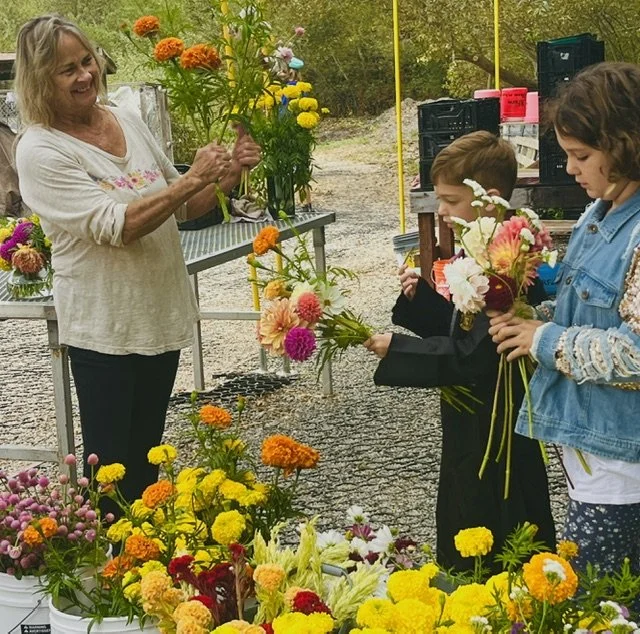
A few days later, on a cool, overcast autumn morning, we climbed into the car and drove the short distance to Common Roots. The moment we arrived, I felt as though we had wandered into a little pocket of enchantment, a place where the hurried rhythms of everyday life seemed to soften and slow. We ambled along a winding path beside rows of vegetables and flowers, the scent of earthy soil permeating the damp air. Fallen leaves in shades of amber and gold skittered around our feet as chickens offered their lively chorus of clucks and cackles. Smiling faces greeted us as we wandered through the gardens. Beyond an outdoor gathering area, where tables invited people to sit, share meals, and linger in conversation, I spotted Terri in the distance. She stood surrounded by buckets overflowing with freshly cut flowers. Crimson, tangerine, sunshine yellow, and soft pink blossoms spilled from their containers like an artist's palette come to life.
She looked up, waved enthusiastically with a huge smile, and called out, "Welcome, Jeri!" After hugs, she sweetly asked Callen and Brielle, my grandchildren, "Would you like to make a bouquet?" Two heads nodded eagerly. Soon, small hands were reaching into buckets considering which colors and which shapes. As the children worked, Terri explained that bouquets are offered to folks who come to the farm to pick up their baskets of fresh, organic vegetables. Bouquets also find their way to a farm friendly program called Blooms of Thanks, as gifts for volunteers and helpers.
"I can help you cut the stems and tie them together," Terri offered, as the children completed their creations. When Callen’s bouquet was finished, he held it up proudly, admiring the colorful blossoms gathered in his little fist. Then he turned toward me, “This is for you Gigi.” With tears in my eyes, I kneeled to him, and held him in my arms. “Thank you, Callen. I love you so much,” I said to my grandson, a child who can be shy about expressing himself so openly.
We continue to create more bouquets until it is time to go. Walking to our car along the path I glance back and there is Terri working among the other volunteers. I am reminded that flowers, for sure, are bright bits of living miracles and magic. Terri standing there is also.
In 2014 Terri was diagnosed with multiple myeloma, a rare blood cancer. Since then, her journey has been marked by years of medical treatments, including chemotherapy, a bone marrow transplant, steroids, and maintenance medications, many accompanied by difficult side effects. With a compromised immune system, she also endured long periods of isolation, particularly during the COVID pandemic, when the simple pleasures of gathering with friends or moving freely through the world became fraught with risk. I could only imagine her years of uncertainty, endless days in the hospital, her days of being lethargic with no energy to pursue her many artistic passions and the courage required to keep going.
As we talked at the farm, she let me know that due to a CAR-t-cell transplant in May 2023, her labs have not detected the cancer. Beautiful Terri, through it all, continues to be a delightful spirit shining her light with an easy smile and loving kindness. One of the things she told me is how she has learned to live day to day, that her worries are manageable this way. When I asked her, "Why did you decide to volunteer making bouquets? She said, “because flowers make people happy.” And then she recalled a painting she had created earlier in her cancer journey. She texted me a photo. In it she had painted her red blood cells as if they were flowers encircled with white petals. She wrote this message on the painting: She believed she could…and so she did cure myeloma!
Intention: Be in awe of flowers. Let them show you the way to joy, kindness, health and beauty. And, of course, hope.
October 20, 2026